0.3 mL of what? Why mL means nothing without concentration (mg/mL)
Scroll through peptide talk on TikTok or Instagram for a minute and someone will announce a volume: "I do 0.3 mL," "I'm at 30 units." It sounds precise. It isn't. A millilitre measures liquid, not compound, and the number of milligrams riding in that liquid depends entirely on how concentrated the vial is. This guide explains the arithmetic behind mL vs mg, shows how one volume can hold very different amounts, covers why compounded GLP-1 products make the problem worse, and walks through our free <a href="/vial-concentration">Lab Calculator</a> so the math is never a guess. It is unit arithmetic and labeling reference only: no dosing, no usage guidance and no effect claims.
Snowman Research does not offer dosing information or usage guidance of any kind. Everything on this page is reference material about research products sold for laboratory research only.
| Bac water added | Concentration (mg/mL) | Compound in 0.3 mL | 0.3 mL on a U-100 syringe |
|---|---|---|---|
| 1 mL | 10 mg/mL | 3 mg | 30 units |
| 2 mL | 5 mg/mL | 1.5 mg | 30 units |
| 3 mL | 3.33 mg/mL | 1 mg | 30 units |
Three measurements that are not interchangeable
- mg (milligrams) is mass: how much compound is present. A vial labeled 10 mg holds 10 mg of peptide no matter what you add to it.
- mL (millilitres) is volume: how much liquid is present. It says nothing on its own about what is dissolved in it.
- mg/mL is concentration: how much compound sits in each millilitre. For a freeze-dried vial it is simply mg in the vial ÷ mL of water added.
Concentration is the bridge between the other two. Multiply a volume by the concentration and you get milligrams; divide milligrams by the concentration and you get a volume. Leave the concentration out and a mL figure is a measurement of water.
Same 0.3 mL, three different answers
The table above uses one 10 mg vial and changes nothing except the amount of bacteriostatic water. With 1 mL of water the solution is 10 mg/mL, so 0.3 mL carries 3 mg. With 3 mL of water it is about 3.33 mg/mL, so the very same 0.3 mL carries 1 mg. Identical syringe reading, a threefold difference in compound. These are round numbers chosen to make the division easy to follow, not amounts anyone should use.
Syringe units do not fix this, because units are also volume. An insulin-style U-100 syringe is marked with 100 units per millilitre, so one unit is 0.01 mL and 30 units is 0.3 mL[1]. "Units" on such a syringe has nothing to do with the "international units" printed on some other products; it is a ruler for liquid. Thirty units of a 10 mg/mL solution and thirty units of a 3.33 mg/mL solution are the same volume holding very different amounts.
Why a mL figure from someone else's vial doesn't transfer
When a person online says "0.3 mL", the useful information is missing: how many milligrams were in their vial and how much water they added. Without those two numbers their volume cannot be translated into anyone else's. Their vial may have been a different size, mixed with a different amount of water, or bought somewhere that sells the same compound at another strength. Repeating the mL figure copies the one part of the statement that only applies to their bottle.
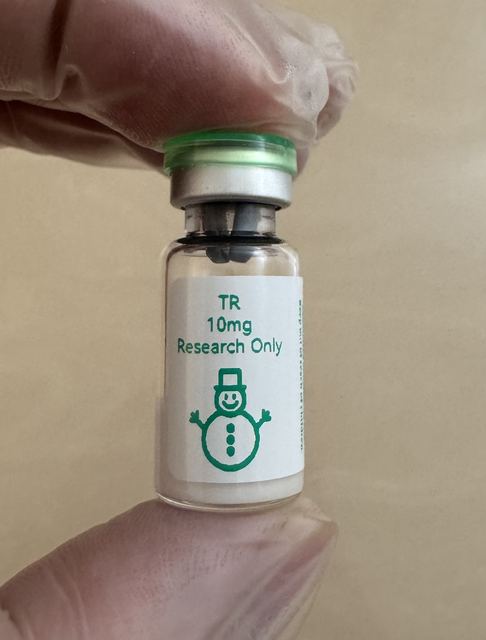
The same goes for your own old vials. A mL number written down for a 5 mg vial mixed with 2 mL of water (2.5 mg/mL) is wrong for a 10 mg vial mixed with 1 mL (10 mg/mL), even though both are the same compound. That gap is a factor of four, which is a lot for a number that sounded so exact. This is also why our own labels print the compound code and the milligrams, such as TR 10mg on a tirzepatide vial or RT 10mg on retatrutide, and never a volume: the mL depends on whoever adds the water.
Compounded GLP-1s: one compound, many strengths
Telehealth services that ship compounded semaglutide or tirzepatide add another layer. The FDA has warned that compounded semaglutide products come in various containers, that product concentrations may vary depending on the compounder, and a single compounder may offer multiple concentrations[1]. In practice that means two pharmacies can supply the same compound at different mg/mL, and a refill can arrive at a different strength from the previous vial, even from the same supplier. A volume or unit count that matched the first vial no longer describes the second.
The FDA has linked this confusion to real errors. Its July 2024 alert describes adverse-event reports in which patients drew up five to 20 times the intended amount from multiple-dose vials, and reports in which health care providers converting milligrams to units or millilitres miscalculated by five to 10 times[1]. The agency noted that instructions accompanying compounded products may be written in "units", whose volume meaning shifts with concentration, and it has repeated its dosing concerns for both compounded semaglutide and tirzepatide[1][2]. Separately, the FDA has pointed out that some compounders express strength differently on their labels from conventional manufacturers, which list strength per total volume first, followed by strength per mL[3]. The practical takeaway is factual, not medical: the only number that describes a vial is the mg/mL printed on its own label.
The branded contrast: fixed volume, changing strength
Eli Lilly's branded tirzepatide shows the same principle from the opposite direction. According to the FDA prescribing information for Mounjaro and Zepbound, every single-dose pen and single-dose vial contains 0.5 mL of solution, in strengths of 2.5 mg/0.5 mL, 5 mg/0.5 mL, 7.5 mg/0.5 mL, 10 mg/0.5 mL, 12.5 mg/0.5 mL and 15 mg/0.5 mL[4][5]. The volume never changes; the concentration runs from 5 mg/mL to 30 mg/mL. Someone saying "I use 0.5 mL of Zepbound" has told you nothing about strength, because every single-dose strength is 0.5 mL.
The labels add a second wrinkle: the multi-dose vial and KwikPen presentations hold 2.4 mL and deliver 0.6 mL per labeled dose, at concentrations from 4.17 mg/mL to 25 mg/mL[4][5]. So even within one brand, the volume depends on the presentation, and only the mg on the label identifies the strength.
Vials also contain a small overfill so the full labeled dose can be withdrawn. US standards require injectable vials to hold slightly more than the labeled volume; USP General Chapter <1151>, which the FDA treats as a requirement for vials and ampules, recommends 0.10 mL of excess for a 0.5 mL container of a free-flowing liquid, about 20% of the labeled volume[6][7]. Lilly's labeling does not state an exact overfill for its vials, but the Zepbound vial instructions tell users to discard an opened vial "even if there is medicine left in the vial", and the KwikPen labeling notes extra volume for device priming[4][8]. Leftover liquid is by design and is not an extra labeled amount.
Doing the math with our Lab Calculator
Our Lab Calculator (the vial concentration calculator) does this division for lab aliquots in a few steps:
- Enter the vial mass in mg, exactly as printed on the label, or pick a Snowman vial from the list to fill it in.
- Enter the solvent volume: the mL of bacteriostatic water that went into the vial.
- Read the concentration in mg/mL and mcg/mL.
- Convert: the table shows how many mg and mcg sit in a given draw volume and how that volume reads on a U-100 scale, and the aliquot box works backward from an amount in mg or mcg to a volume.
Change the water volume and watch every row move while the vial's total milligrams stay put. That is the whole point of this guide in one screen. The vial concentration calculator is arithmetic for laboratory work; it does not suggest amounts for any purpose.
How to talk about it clearly
If you write or talk about a solution, give the numbers that survive being copied:
- Lead with mg, not mL or units. Milligrams mean the same thing in every vial.
- State the concentration in mg/mL, or the two numbers behind it: vial mg and water mL.
- Name the syringe scale if you mention units, and translate it back to mL.
- Re-check after any change of vial size, water volume, supplier or refill, and run the numbers again in the Lab Calculator.
A sentence like "10 mg vial, 2 mL of water, 5 mg/mL" can be checked by anyone. "0.3 mL" can only be repeated.
On our shelf
-
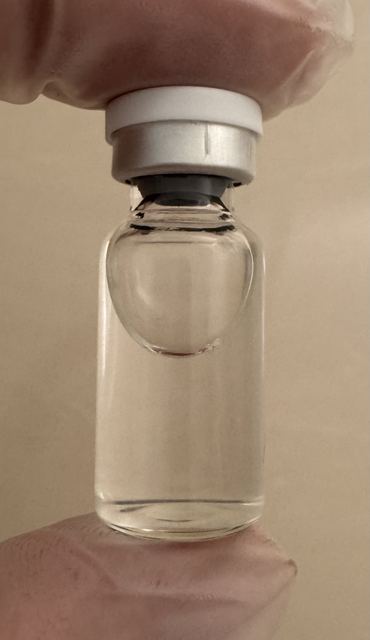
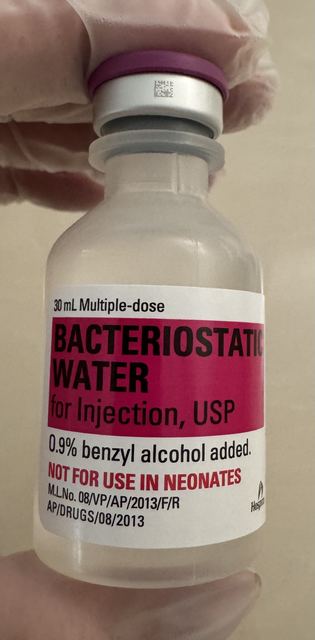
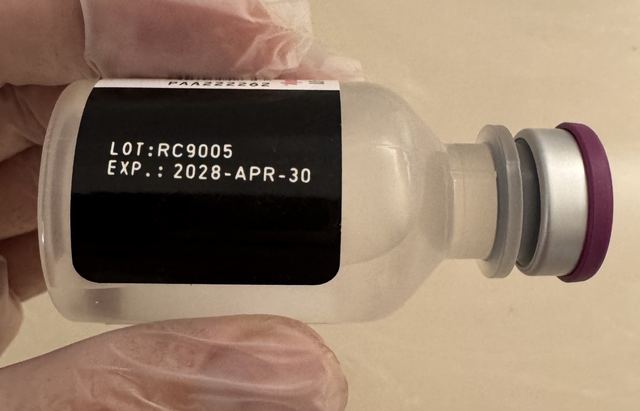
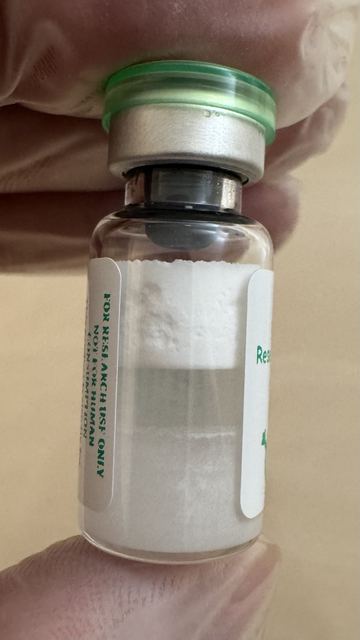
Bacteriostatic water, 3ml vials
$5.00 USD
-
-
Quick questions
How many mg are in 0.3 mL?
It depends on the concentration. Multiply 0.3 by the mg/mL figure: at 10 mg/mL, 0.3 mL holds 3 mg; at 5 mg/mL it holds 1.5 mg; at 3.33 mg/mL it holds about 1 mg. These are arithmetic examples only, not suggested amounts.
Is mL the same as mg?
No. mL measures volume and mg measures mass. They are linked only through concentration (mg/mL), which depends on how much compound and how much liquid are in the vial.
How many units is 0.3 mL on an insulin syringe?
A U-100 syringe is graduated at 100 units per mL, so 0.3 mL reads as 30 units. Units here are a volume scale, so the amount of compound in 30 units still depends on the concentration.
Why do compounded semaglutide concentrations differ?
The FDA notes that concentrations of compounded semaglutide may vary depending on the compounder, and that one compounder may offer several concentrations. Always read the mg/mL on the label of the vial in hand rather than relying on a number from an earlier vial.
Does adding more bac water change how much peptide is in the vial?
No. The vial still holds its labeled milligrams; extra water only dilutes them, so each mL, and each unit mark, carries less compound.
Sources
- FDA alerts health care providers, compounders and patients of dosing errors associated with compounded injectable semaglutide products. U.S. Food and Drug Administration, July 2024. https://www.fda.gov/drugs/human-drug-compounding/fda-alerts-health-care-providers-compounders-and-patients-dosing-errors-associated-compounded
- FDA's concerns with unapproved GLP-1 drugs used for weight loss. U.S. Food and Drug Administration, updated October 2026. https://www.fda.gov/drugs/drug-alerts-and-statements/fdas-concerns-unapproved-glp-1-drugs-used-weight-loss
- Differences in strength expression on product labels of compounders and conventional manufacturers may lead to dosing errors. U.S. Food and Drug Administration. https://www.fda.gov/drugs/human-drug-compounding/differences-strength-expression-product-labels-compounders-and-conventional-manufacturers-may-lead
- ZEPBOUND (tirzepatide) injection, prescribing information, sections 3 and 11. Eli Lilly and Company. Drugs@FDA. https://www.accessdata.fda.gov/drugsatfda_docs/label/2026/217806s042lbl.pdf
- MOUNJARO (tirzepatide) injection, prescribing information, sections 3 and 11. Eli Lilly and Company. Drugs@FDA. https://www.accessdata.fda.gov/drugsatfda_docs/label/2026/215866s044s045lbl.pdf
- Allowable Excess Volume and Labeled Vial Fill Size in Injectable Drug and Biological Products: Guidance for Industry. U.S. Food and Drug Administration, CDER/CBER. https://www.fda.gov/files/drugs/published/Allowable-Excess-Volume-and-Labeled-Vial-Fill-Size-in-Injectable-Drug-and-Biological-Products.pdf
- USP General Chapter <1151> Pharmaceutical Dosage Forms, Injections: recommended excess volume table (USP 29-NF 24 text). http://www.pharmacopeia.cn/v29240/usp29nf24s0_c1151s34.html
- ZEPBOUND single-dose vial, Instructions for Use. Eli Lilly and Company. https://pi.lilly.com/us/zepbound-vial-us-ifu.pdf
For laboratory research use only. Not for human or veterinary use, not FDA-approved, and nothing on this page is medical advice. You must be 21 or older to purchase.